Precision Piling & Shoring
Bored piling is a foundational method that involves boring a precise circular hole into the ground, installing robust steel reinforcement, and filling the borehole with laboratory-grade concrete. This creates a high-capacity pile for structural stability.
Geo-Studies is a pioneer of piling and shoring works in Pakistan, delivering engineering certainty for critical industrial infrastructure. Our bored piles are engineered to withstand extreme vertical and horizontal loads, ensuring the longevity of heavy industrial installations.
The Bored Piling Process
The bored piling process begins with a detailed geotechnical investigation to determine the depth and bearing capacity of the founding stratum. Once the soil profile is established, our drilling rigs are mobilised to the site and positioned precisely over the pile layout coordinates. A rotary drilling head bores a cylindrical hole to the specified diameter � typically ranging from 300 mm to 1,200 mm � and to the required depth, which may extend from 10 metres to over 40 metres depending on the structural load and soil conditions.
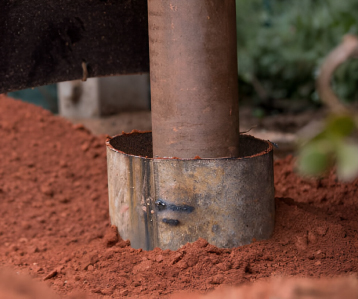
In unstable or water-bearing soils, temporary steel casing is advanced into the borehole as drilling progresses. This casing prevents the borehole walls from collapsing and keeps the excavation clean and dimensionally accurate. Where the soil is cohesive and self-supporting, drilling fluid or bentonite slurry may be used as an alternative to casing, maintaining hydrostatic pressure against the borehole walls throughout the excavation phase.
Steel Reinforcement Cage Placement
Once the borehole reaches the target depth, the base is cleaned of loose cuttings using a cleaning bucket or air-lift technique to ensure full contact between the pile toe and the bearing stratum. A prefabricated steel reinforcement cage � assembled to the structural engineer's specification � is then carefully lowered into the borehole. The cage consists of longitudinal high-yield steel bars arranged in a circular pattern and bound by helical links at regular intervals. Spacers are attached to the cage to maintain the correct concrete cover on all sides, protecting the steel from corrosion throughout the pile's service life.
The reinforcement cage is designed to carry the tensile and bending forces that the pile will experience under load. For piles subject to lateral loads � such as those supporting retaining walls, bridge abutments, or structures in seismic zones � additional horizontal reinforcement and closer link spacing are specified to enhance ductility and shear resistance.
Concrete Specification and Placement
Concrete is placed using a tremie pipe that extends to the base of the borehole, ensuring the mix is deposited from the bottom upward and displacing any drilling fluid or water without segregation. The concrete specification for bored piles typically requires a minimum characteristic compressive strength of 25 to 35 MPa, with a slump of 150�200 mm to achieve adequate workability for tremie placement. Admixtures are incorporated to control setting time and improve durability in aggressive ground conditions, including sulphate-bearing soils common in parts of Sindh and Balochistan.
As concrete is placed, the tremie pipe is gradually withdrawn and the temporary casing is extracted in a controlled manner, maintaining a positive head of concrete above the casing shoe at all times. This prevents soil or groundwater from entering the fresh concrete and ensures a continuous, defect-free pile shaft. After curing, the pile head is broken down to expose sound concrete and the reinforcement cage is connected to the pile cap or ground beam.
Load-Bearing Capacity Calculations
The load-bearing capacity of a bored pile is determined by two mechanisms: end bearing at the pile toe and skin friction along the pile shaft. Geo-Studies engineers calculate pile capacity using established methods including the alpha method for cohesive soils and the beta method for granular soils, calibrated against the Standard Penetration Test (SPT) data and laboratory test results from the site investigation. For critical projects, static load tests are conducted on trial piles to verify the design assumptions and confirm that the pile can sustain the specified working load with an adequate factor of safety.
Pile capacities for our projects range from a few hundred kilonewtons for light industrial structures to several thousand kilonewtons for high-rise residential towers and heavy industrial plant foundations. The pile diameter, length, and concrete grade are optimised for each project to achieve the most economical design without compromising structural integrity.
Shoring and Soil Stabilization
In addition to vertical load-bearing piles, Geo-Studies designs and installs contiguous and secant pile walls for shoring and soil stabilisation applications. These systems are used to support excavations for basements, underground car parks, and deep utility trenches in urban environments where space constraints prevent the use of conventional open-cut slopes. Contiguous pile walls consist of closely spaced bored piles that act as a retaining structure, while secant pile walls use interlocking primary and secondary piles to form a watertight barrier against groundwater ingress.
Shoring pile walls are designed to resist the lateral earth pressure and surcharge loads from adjacent structures and traffic. Temporary or permanent ground anchors and steel walers are incorporated where required to provide additional lateral support at multiple levels as the excavation is deepened. This approach allows construction to proceed safely in congested urban sites without disturbing neighbouring foundations or utilities.
Applications in High-Rise and Industrial Construction
Bored pile foundations are the preferred solution for high-rise residential and commercial buildings in Karachi and other major Pakistani cities, where the upper soil layers are typically composed of loose alluvial deposits, reclaimed land, or soft marine clays that cannot support the concentrated column loads of multi-storey structures on shallow foundations. By transferring loads to the dense sand and gravel layers or weathered rock at depth, bored piles provide the settlement control and bearing capacity required for tall buildings.
In the industrial sector, bored piles support heavy machinery foundations, storage tank bases, power plant structures, and bridge piers where differential settlement must be minimised to protect process equipment and structural connections. Geo-Studies has delivered pile foundation solutions for textile mills, pharmaceutical manufacturing facilities, food processing plants, and petrochemical installations across Sindh, Punjab, Khyber Pakhtunkhwa, and Balochistan.
Borehole Precision
Utilizing advanced drilling rigs to ensure perfectly vertical and accurately sized bores for high-capacity piles.
Steel Reinforcement
Strategic placement of heavy steel cages to provide structural tensile strength and lateral stability.
Technical Compliance
Adhering to strict engineering standards for concrete quality and pile diameter to meet industrial project requirements.