Advanced Water Control Solutions
Construction dewatering and unwatering are essential processes for removing or draining groundwater from excavation sites, riverbeds, or mineshafts. This process is critical before the excavation of foundations, shoring, or cellar space to lower the water table and ensure a safe, dry working environment. Without effective dewatering, excavations in water-bearing formations become unstable, dangerous, and impossible to work in � making a well-designed dewatering system a prerequisite for any deep excavation project in Pakistan's alluvial plains.
Geo-Studies provides specialist dewatering bore services for industrial and construction clients across Sindh, Punjab, Khyber Pakhtunkhwa, and Balochistan. Our dewatering systems are engineered to the specific hydrogeological conditions of each site, taking into account the depth of the excavation, the permeability of the water-bearing formation, the required drawdown, and the proximity of existing structures that could be affected by changes in the groundwater regime.
The Groundwater Removal Process
Our dewatering typically involves the integration of submersible dewatering pumps and centrifugal (trash) pumps. We apply vacuum to wellpoints and deep wells to maintain the structural stability of the surrounding soil while work is underway. The dewatering process begins with a site investigation to determine the depth and extent of the water-bearing formation, the hydraulic conductivity of the aquifer material, and the static groundwater level. This data is used to design the dewatering system � selecting the appropriate method, determining the number and spacing of dewatering bores, and specifying the pump capacity required to achieve the target drawdown within the project schedule.
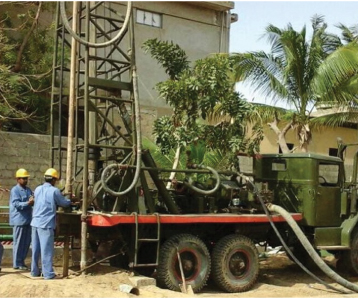
Once the system design is finalised, Geo-Studies mobilises its drilling equipment to install the dewatering bores around the perimeter of the planned excavation. Each bore is drilled to the required depth, cased with slotted liner opposite the water-bearing zone, and fitted with a submersible pump. The pumps are connected to a discharge manifold and the extracted groundwater is directed to a suitable disposal point � typically a settlement pond, a drainage channel, or a municipal stormwater system, depending on the site conditions and local regulations.
Pumping commences before excavation begins, and the system is operated continuously until the groundwater level has been drawn down to a safe level below the excavation base. Monitoring standpipes are installed at strategic locations around the site to track the progress of the drawdown and confirm that the target water level has been achieved before excavation proceeds. Throughout the excavation phase, the dewatering system continues to operate to maintain the dry working conditions, with pump performance monitored regularly to detect any reduction in yield that might indicate pump wear, screen blockage, or changes in the aquifer.
Deep Well Dewatering Systems
Deep well dewatering is the method of choice for excavations deeper than approximately six metres, where the drawdown required exceeds the practical limit of wellpoint systems. In a deep well system, boreholes are drilled to a depth below the base of the planned excavation and fitted with slotted liners and electric submersible pumps. Each pump operates independently, drawing water from the aquifer and discharging it to the surface. The combined effect of multiple pumping wells creates a cone of depression in the groundwater surface that extends across the excavation footprint, lowering the water table to the required level.
Geo-Studies dewatering bores can be installed to depths of 30 metres or more, depending on the depth of the excavation and the depth of the water-bearing formation. For very deep excavations � such as those required for basement construction in high-rise developments, underground infrastructure, or deep industrial foundations � the dewatering system may need to target multiple aquifer zones at different depths, requiring a more complex multi-stage pumping arrangement. Geo-Studies has the technical capability and equipment to design and install multi-stage deep well systems for the most demanding excavation projects.
Wellpoint Arrays for Shallow Excavations
For shallower excavations in sandy or silty soils, wellpoint dewatering offers a cost-effective alternative to deep well systems. Wellpoints are small-diameter tubes � typically 38 to 50 millimetres in diameter � inserted at close centres around the perimeter of the excavation. Each wellpoint is connected via a swing connection to a header pipe, which in turn is connected to a vacuum-assisted centrifugal pump. The vacuum applied by the pump draws water from the soil through the wellpoints and into the header pipe, from where it is discharged away from the site.
Wellpoint systems are particularly effective in fine-grained sandy soils where the capillary fringe above the water table can cause instability in the excavation walls. By applying vacuum to the wellpoints, the system not only lowers the water table but also increases the effective stress in the soil above the water table, improving the stability of the excavation slopes and reducing the risk of piping or heave at the excavation base. Geo-Studies installs wellpoint arrays for excavations up to approximately six metres deep, and can combine wellpoint and deep well systems for excavations that pass through multiple soil layers with different permeabilities.
Horizontal Drainage Systems
In some site conditions � particularly where the water-bearing formation is a thin, laterally extensive layer rather than a deep aquifer � horizontal drainage offers an efficient dewatering solution. Geo-Studies installs perforated pipes at the appropriate depth within the water-bearing layer, either by directional drilling or by open-cut installation in a gravel-filled trench. The perforated pipes collect groundwater by gravity and direct it to a sump or collection point, from where it is pumped to the surface. High-capacity pumping is then used to lower the water table across the site to the required level.
Horizontal drainage is commonly used in riverbed construction projects, where the water-bearing formation is a shallow gravel or sand layer beneath the riverbed. Geo-Studies has experience in riverbed dewatering for bridge foundation construction, pipeline crossings, and other infrastructure projects that require dry working conditions in or adjacent to watercourses. The design of horizontal drainage systems for riverbed applications requires careful consideration of the interaction between the dewatering system and the river flow, and Geo-Studies works closely with the project's civil and hydraulic engineers to ensure that the dewatering design is compatible with the overall construction methodology.
Grundfos and Komax KPS Submersible Pumps
The performance of a dewatering system depends critically on the reliability and efficiency of the submersible pumps used. Geo-Studies uses Grundfos SP series submersible pumps and Komax KPS submersible pumps as its primary dewatering pump equipment. These pumps are selected based on the required flow rate, total dynamic head, and the depth of the dewatering bores, ensuring that each pump is operating within its optimal performance range for maximum efficiency and longevity.
The Grundfos SP series is a range of stainless steel submersible pumps designed for clean water applications, including dewatering from boreholes and deep wells. The SP series pumps are available in a wide range of flow rates and head capacities, making them suitable for dewatering bores of varying depths and yields. Their stainless steel construction provides excellent corrosion resistance in the aggressive groundwater conditions commonly encountered in Pakistan's coastal and industrial areas, and their modular design allows for easy maintenance and repair in the field.
The Komax KPS submersible pump range is specifically designed for construction dewatering applications, with robust construction and high solids-handling capability that makes them suitable for use in turbid or slightly silty groundwater conditions. The KPS pumps are available in both single-phase and three-phase configurations, providing flexibility for sites where only single-phase power is available. Geo-Studies maintains a stock of both Grundfos SP and Komax KPS pumps in various sizes, allowing rapid mobilisation and pump replacement in the event of equipment failure during a critical dewatering operation.
Construction and Riverbed Applications
Geo-Studies dewatering services are used across a wide range of construction and civil engineering applications in Pakistan. Building foundation excavations � particularly for multi-storey commercial and industrial buildings in Karachi, Lahore, and other major cities � frequently encounter groundwater at shallow depths, requiring dewatering before pile installation, raft foundation construction, or basement slab placement can proceed. Industrial facility construction, including factories, warehouses, and process plants, often involves large-footprint excavations that require extensive dewatering systems to maintain dry working conditions across the entire excavation area.
Infrastructure projects � including road underpasses, railway tunnels, utility trenches, and stormwater drainage systems � are among the most demanding dewatering applications, as they typically involve long, narrow excavations that must be kept dry for extended periods while construction proceeds along the alignment. Geo-Studies has the equipment and experience to design and operate dewatering systems for linear infrastructure projects, including the progressive relocation of dewatering equipment as the excavation advances along the alignment.
Deep Well Systems
Featuring boreholes fitted with slotted liners and electric submersible pumps, forming a cone of depression to lower water levels effectively.
Wellpoint Arrays
Small-diameter tubes inserted in close centres around excavations, utilising vacuum pumps to draw water from sandy soil conditions.
Horizontal Drainage
Installation of perforated pipes at common depths followed by high-capacity pumping to lower the water table across the site.